


Japanese Yen Analysis: USD/JPY Near Intervention Risk
Japanese yen weakness keeps forex traders on alert
The Japanese yen remains under pressure against the US dollar, keeping USD/JPY near levels that have drawn renewed attention to possible intervention from Japanese authorities. On 6 July 2026, Reuters reported that the yen was trading around 162.07 per dollar, close to a recent 1986-era low of 162.84.
For forex traders, the key issue is not only the exchange rate itself. The speed of the move, the wide interest-rate gap between Japan and the United States, and the possibility of official action all matter for short-term volatility. This makes Japanese yen analysis especially relevant while USD/JPY remains near historically sensitive levels.
Why the yen remains under pressure
The main driver is still the gap between Japanese and US interest rates. The Bank of Japan decided on 16 June 2026 to guide the uncollateralised overnight call rate to around 1.0%, confirming that Japan has continued to move away from ultra-loose policy.
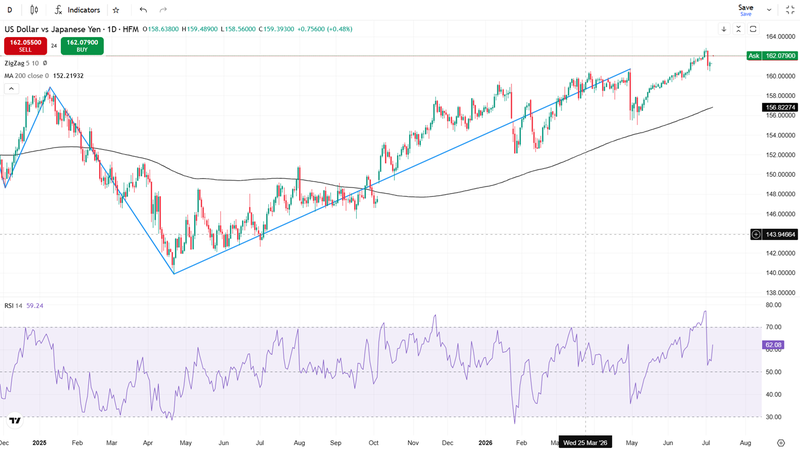
However, US rates remain higher. The Federal Reserve kept the federal funds target range at 3.50%–3.75% at its 17 June 2026 meeting, maintaining a clear rate premium for the US dollar over the yen.
This gap can keep the dollar supported, particularly when US yields remain firm. At the same time, the outlook is not one-sided. If US inflation, labour-market or growth data weaken expectations for higher-for-longer rates, the dollar could lose some momentum and give the yen temporary relief.
Intervention risk is the main short-term uncertainty
Japan has already acted this year to support its currency. Ministry of Finance data show foreign exchange intervention operations of ¥11,734.9 billion between 28 April and 27 May 2026.
That intervention confirms that official action is not just a theoretical risk. Still, another intervention is not guaranteed. Authorities typically watch the pace and disorderliness of currency moves, not only a single exchange-rate level.
Reuters has also reported that Japan may be shifting away from a fixed “line in the sand” and toward a more flexible approach that keeps traders alert for sudden action. This uncertainty can make short-yen positioning more sensitive to comments from Japanese officials, especially during periods of thin liquidity.
What USD/JPY means for wider markets
The immediate focus is USD/JPY, but yen weakness can also influence EUR/JPY, GBP/JPY and AUD/JPY. If traders begin to price in a higher risk of intervention, positions across yen crosses could adjust quickly.
A weaker yen can also support carry-trade strategies, where investors borrow in lower-yielding currencies and seek returns elsewhere. However, that same positioning can become vulnerable if intervention, softer US data or a sudden shift in risk sentiment triggers a rapid yen rebound.
For leveraged forex and CFD traders, this environment may increase volatility. Risk management remains important because macro events, central-bank communication and intervention speculation can all trigger sharp intraday moves.
Scenarios traders are watching
One possible scenario is stabilisation in USD/JPY if upcoming US data reduce expectations for further Fed tightening. In that case, the yen could find some support without direct intervention.
A second scenario is renewed yen pressure if US yields rise again or if the Fed keeps a firm tone on inflation. That could lead markets to test how much weakness Japanese authorities are willing to tolerate.
A third scenario is stronger verbal intervention or direct official action. This could trigger a sharp move in favour of the yen, although its durability would depend on whether the underlying rate and macro backdrop also shifts.
Key catalysts ahead
Traders will be watching Federal Reserve minutes, US inflation data, comments from Japan’s Ministry of Finance and any signal from the Bank of Japan on the pace of future policy normalisation. Reuters noted that Fed minutes and upcoming inflation figures are among the next important catalysts for dollar sentiment.
The yen remains caught between two forces: a rate differential that still favours the US dollar and intervention risk that may limit disorderly moves. While USD/JPY stays close to multi-decade extremes, volatility may remain elevated and the outlook will depend heavily on central-bank signals, US macro data and Japan’s tolerance for further currency weakness.


Terms and Conditions apply
Click here to access our Economic Calendar.
Disclaimer: This material is provided as a general marketing communication for information purposes only and does not constitute an independent investment research. Nothing in this communication contains, or should be considered as containing, an investment advice or an investment recommendation or a solicitation for the purpose of buying or selling of any financial instrument. All information provided is gathered from reputable sources and any information containing an indication of past performance is not a guarantee or reliable indicator of future performance. Users acknowledge that any investment in Leveraged Products is characterized by a certain degree of uncertainty and that any investment of this nature involves a high level of risk for which the users are solely responsible and liable. We assume no liability for any loss arising from any investment made based on the information provided in this communication. This communication must not be reproduced or further distributed without our prior written permission.
Jarek Duque
Financial markets analyst with over 10 years of technical and operational experience in the FX and CFDs sector. Jarek has been an integral part of large-scale international projects, managing content localization and the implementation of educational frameworks for global firms across multiple regions. His participation in market expansion across APAC and Latam provides him with a privileged understanding of the macroeconomic factors driving today's industry. Recognized for his work as a leader in financial training, he has coordinated live education programs for international audiences. Today, he leverages this extensive background to offer a rigorous analytical perspective connected to the reality of global markets and the world economy.
