

Market Briefing: Tech Sell-Off, Gold Rebound and Rising Geopolitical Tensions Shake Global Markets
Global financial markets experienced heightened volatility as investors navigated political developments in the US and Europe, renewed geopolitical risks, sharp rotations within equities, and extreme price swings in precious metals. While risk appetite has not collapsed, sentiment has clearly shifted toward caution, diversification, and selective positioning.
US Politics and the Federal Reserve: Markets Look Past the Shutdown
US President Donald Trump signed a bill to end the latest government shutdown, an event that had little impact on markets. Investors appear increasingly desensitised to US political disruptions, treating them as background noise rather than systemic risks.
More attention was paid to developments surrounding the Federal Reserve. Democrats signalled unified opposition to confirming former Fed governor Kevin Warsh as the next Fed chair unless the administration halts its legal actions against the central bank. While expected, this raises the possibility that Jerome Powell could remain as FOMC Chair beyond May. For markets, continuity at the Fed is viewed as supportive, particularly at a time when confidence in institutional independence is being closely scrutinised.
Europe: Fiscal Uncertainty Persists as Inflation Cools
France passed its 2026 budget after the government survived a vote of confidence. Although this avoided immediate political instability, the country’s longer-term fiscal challenges remain unresolved. Markets largely absorbed the news calmly, viewing France’s fiscal position as less destabilising than ongoing US budget concerns.
Across the Eurozone, flash estimates for January consumer price inflation are expected to confirm further disinflation, with headline CPI slowing to around 1.7% year-on-year. Cooling inflation continues to support real income growth, offering a constructive foundation for European economic activity despite political uncertainty.
US Equity Markets: Technology Under Pressure
Wall Street retreated as technology stocks led a broad rotation away from growth. The S&P 500 fell 0.8%, the Dow Jones slipped 0.3%, and the Nasdaq Composite dropped 1.4%.
Major technology names weighed on sentiment, with Nvidia and Microsoft both declining close to 3%. Investors remain concerned about elevated valuations and whether heavy spending on artificial intelligence infrastructure will translate into sustainable earnings. PayPal plunged more than 20% following weaker-than-expected results, while Pfizer declined despite posting stronger quarterly profits, highlighting the market’s increasingly selective response to earnings.
Asian Markets: Mixed Performance Amid Tech Weakness
Asian equities were mixed, reflecting the overnight decline in US technology stocks. Japan’s Nikkei 225 fell 0.6%, pressured by losses in semiconductor-related stocks such as Tokyo Electron and Advantest. Nintendo shares plunged more than 10% despite strong earnings, as investors questioned whether sales momentum for the Switch 2 console can be maintained.
South Korea’s Kospi rose 0.9%, continuing to set record highs despite weakness in major chipmakers Samsung Electronics and SK Hynix. Hong Kong’s Hang Seng slipped 0.4%, while mainland China’s Shanghai Composite was flat.
Software stocks across Asia came under particular pressure following developments in artificial intelligence that threaten traditional software-as-a-service business models. Indian IT leaders Tata Consultancy Services and Infosys fell sharply, while Australia’s Xero and Japan’s Nomura Research Institute also posted significant losses. These declines were partly offset by gains in financials and industrials, reinforcing the theme of sector rotation rather than broad risk aversion.
Commodities: Gold and Silver Rebound After Historic Sell-Off
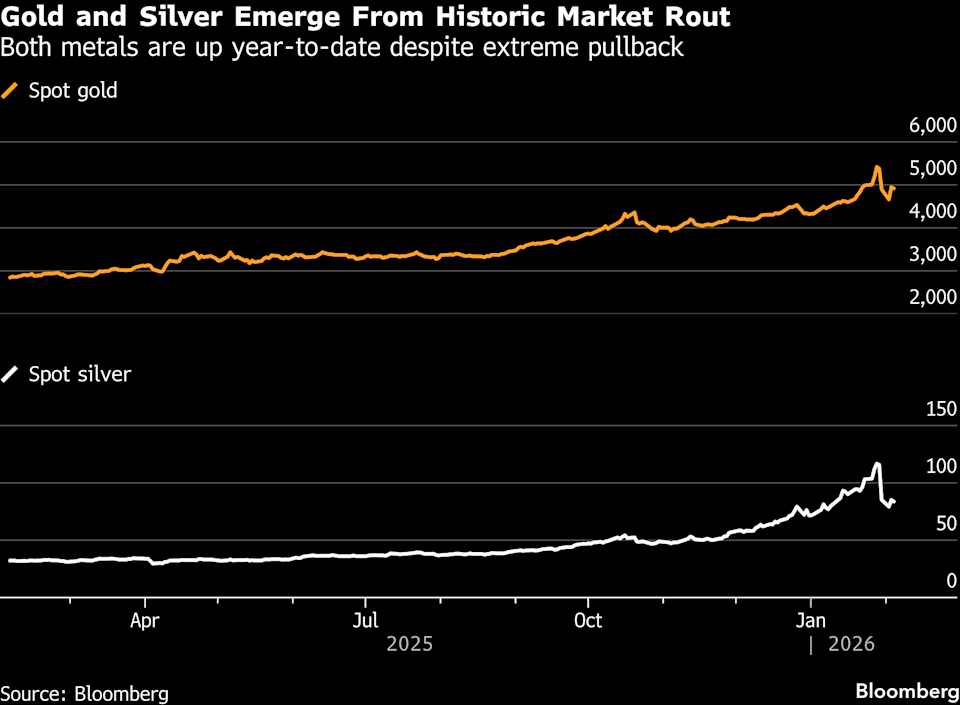
Precious metals staged a strong rebound after last week’s sharp collapse. Gold rose nearly 4%, reclaiming levels above $5,000 an ounce, while silver jumped more than 5% following heavy liquidation-driven losses.
The rebound was driven by dip-buying as forced selling eased and the US dollar weakened. Despite extreme volatility, analysts argue the broader macro case for gold remains intact. Safe-haven demand, geopolitical uncertainty, concerns over Federal Reserve independence, and central bank diversification continue to support bullion over the medium to long term. Several major banks have reiterated bullish outlooks, even as near-term volatility remains elevated.
Oil Prices Rise on Renewed Gulf Tensions
Oil prices advanced for a second consecutive session after geopolitical tensions resurfaced in the Gulf. Brent crude traded near $68 per barrel, while WTI moved toward $64, following reports that the US Navy shot down an Iranian drone near an aircraft carrier.
Energy markets remain sensitive to even limited incidents in the region, with analysts warning that miscalculations could lead to rapid escalation. For now, price action reflects a modest geopolitical risk premium rather than supply disruption concerns.
Currencies and Crypto: Yen Weakens, Bitcoin Stabilises
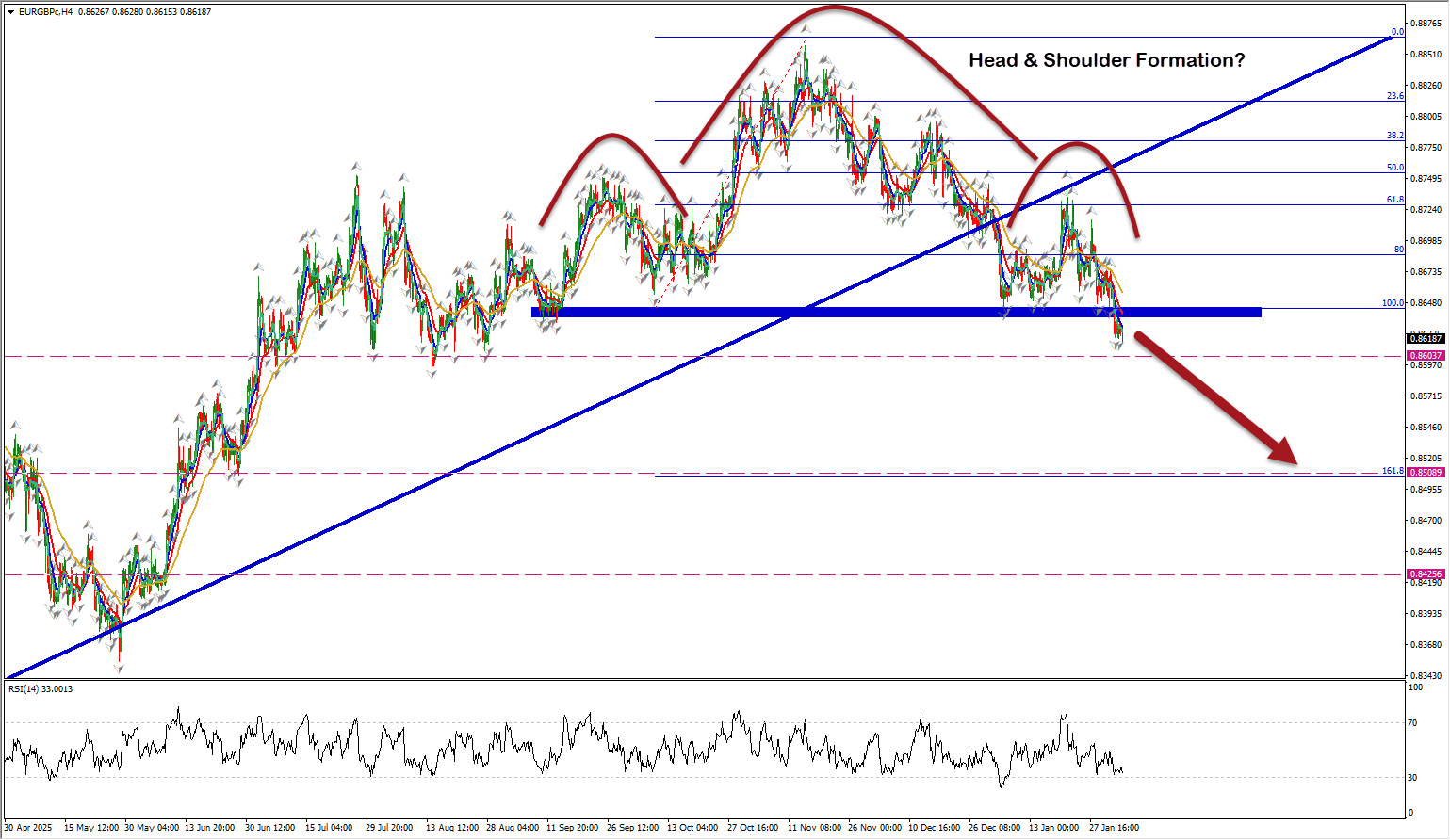
In currency markets, the US dollar was broadly steady. The Japanese yen weakened ahead of Japan’s upcoming election, with investors positioning for potential fiscal stimulus that could increase government debt. The euro edged higher, supported by easing inflation expectations in the Eurozone.
Bitcoin rebounded modestly in Asian trading after falling to a more-than-one-year low during US hours. However, sentiment remains fragile, with concerns that further declines could intensify stress across crypto-exposed companies and leveraged products.
Market Outlook: Volatility Favours Active Traders
The dominant theme across global markets is rotation rather than capitulation. Investors are reassessing technology exposure, rotating into value sectors, and selectively increasing allocations to defensive and safe-haven assets. With geopolitical risks simmering, political uncertainty persisting, and AI-driven disruption accelerating, volatility is likely to remain a defining feature of the trading environment.
For traders, the current landscape rewards disciplined risk management, flexibility, and close monitoring of cross-asset signals as markets continue to adjust to a rapidly evolving macro backdrop.


Terms and Conditions apply
Click here to access our Economic Calendar.
Disclaimer: This material is provided as a general marketing communication for information purposes only and does not constitute an independent investment research. Nothing in this communication contains, or should be considered as containing, an investment advice or an investment recommendation or a solicitation for the purpose of buying or selling of any financial instrument. All information provided is gathered from reputable sources and any information containing an indication of past performance is not a guarantee or reliable indicator of future performance. Users acknowledge that any investment in Leveraged Products is characterized by a certain degree of uncertainty and that any investment of this nature involves a high level of risk for which the users are solely responsible and liable. We assume no liability for any loss arising from any investment made based on the information provided in this communication. This communication must not be reproduced or further distributed without our prior written permission.
Andria Pichidi
Having completed her five-year-long studies in the UK, Andria Pichidi has been awarded a BSc in Mathematics and Physics from the University of Bath and a MSc degree in Mathematics, while she holds a postgraduate diploma (PGdip) in Actuarial Science from the University of Leicester.
Following her various academic endeavours, Andria set eyes on the fascinating Forex industry where she has obtained valuable experiences after being active in the field for the past few years. In 2016, she joined HFM as a Market Analyst with a mission to actively support the company’s clients in becoming better traders, by delivering daily market reviews.
