

Why the Canadian Dollar Isn’t Rising Despite Surging Oil Prices
Amidst the escalating military conflict rocking the Middle East, global markets are witnessing an anomalous phenomenon that is placing the Canadian economy in a tight spot. Although West Texas Intermediate (WTI) crude oil prices surged more than 3% to $78 per barrel, the Canadian dollar (loonie) failed to capitalise on these gains, stalling at a one-month low of $1.37 per US dollar.
The Canadian currency's inability to recover amid this commodity rally reflects the struggle between external geopolitical forces and increasingly apparent domestic structural vulnerabilities.
Supply Threatened, Currency Under Pressure
Historically, rising oil prices have been a welcome relief for Canada as one of the world's major energy exporters. Iran's closure of the Strait of Hormuz, a vital route for 20% of global oil supplies, has sparked fears of a major disruption.
However, the energy sector's momentum this time was overshadowed by the US dollar's safe-haven status. Global investors preferred to secure their assets in the US currency following the sinking of an Iranian warship by a US submarine off the coast of Sri Lanka. In this climate of fear, the positive correlation between oil prices and the Loonie began to break down, as the market prioritised capital security over the prospects for commodity exports.
Domestic Burdens, GDP Contraction, and Interest Rate Pressure
Behind the shadow of global conflict, Canada's domestic economic health is sending warning signals. The latest data confirms this:
- Slowing Growth: Canada's GDP contracted by 0.6% in the fourth quarter, marking the slowest growth period since 2020.
- Policy Dilemma: The Bank of Canada (BoC) now faces an impossible task: balancing soaring energy costs (which fuel inflation) with a cooling domestic economy (which requires lower interest rates).
- Manufacturing Sector: Although the February manufacturing PMI reached a 13-month high of 51, this optimism was tempered by global trade uncertainty.
Pressure and the Threat of 15% Tariffs
Another external factor weighing on Canada is Washington's trade policy. Treasury Secretary Scott Bessent has confirmed that President Donald Trump's 15% global tariff plan will likely take effect later this week.
While Canada has secured some favourable trade exemptions, the threat of US protectionism remains a cloud over Canada's export prospects. With the US Dollar Index hovering above 99, Canada's competitiveness is being tested amid expectations that the Federal Reserve will maintain high interest rates for longer to curb inflation.
Looking for a Turning Point
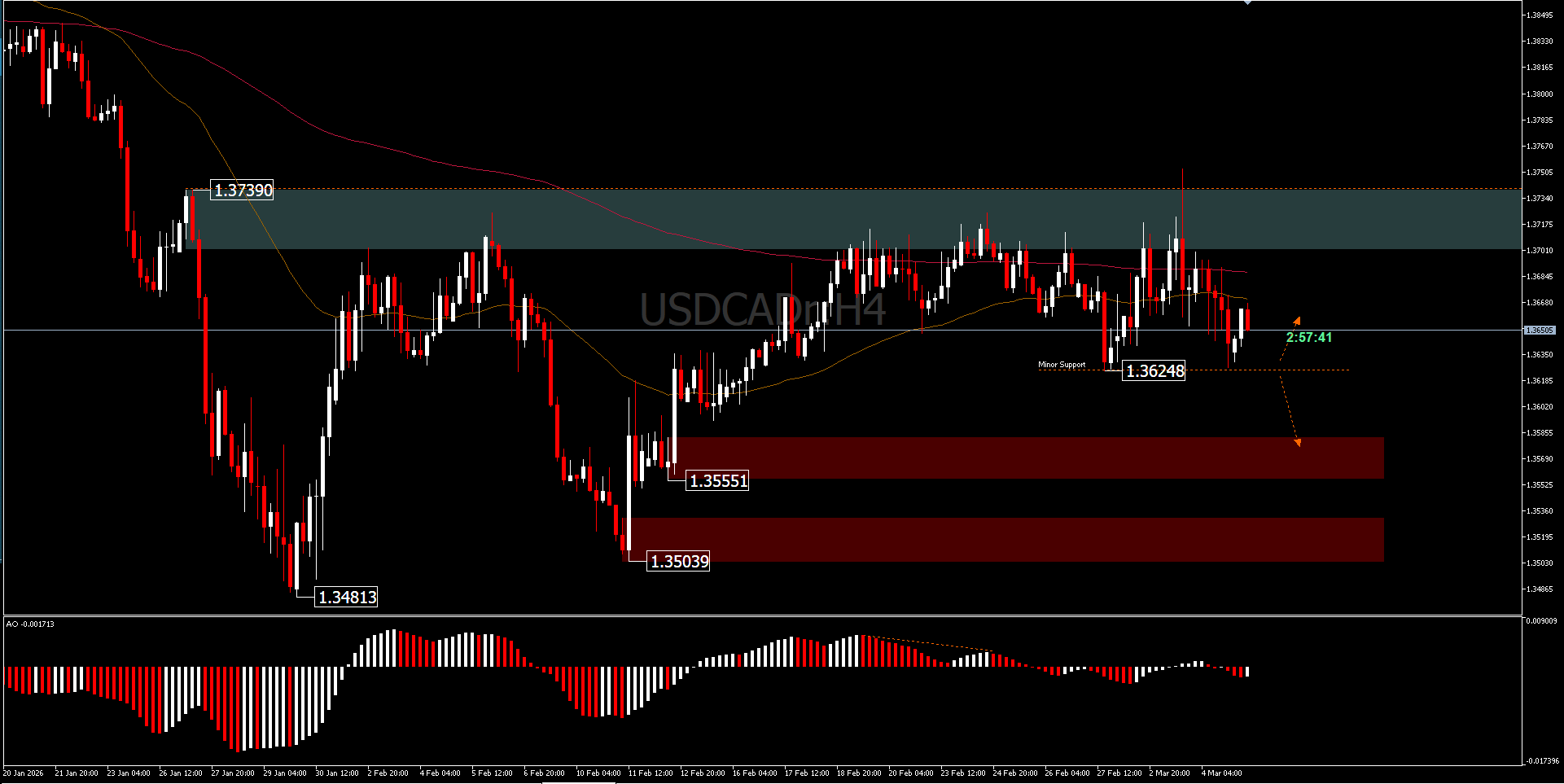
The market now awaits the release of more detailed US jobless claims and employment data to determine its next direction. Technically, the USDCAD currency pair is in a delicate balance; support from oil prices acts as a hedge preventing further weakening of the Loonie, but the lack of domestic economic momentum prevents a significant recovery.
For Canada, the key challenge in 2026 will no longer be simply energy production, but how to navigate capital flows away from riskier markets as the domestic economy begins to slow.
Structurally, USD/CAD is currently in a sideways consolidation phase following a medium-term downtrend that began at the peak in early 2025. The market structure suggests that while buyers have a slight structural advantage, they still lack the momentum to stage a decisive breakout. Volatility will be determined by two critical thresholds: if the price slips below minor support at 1.3624, a retest of 1.3555/1.3500 will become the market's top priority. Conversely, a decisive break above the 200-day moving average (EMA) on the 4th day would invalidate the current consolidation structure and trigger a much more aggressive rebound towards a retest of resistance at 1.3739.
The question is, will the US dollar's safe-haven sentiment be strong enough to break through this technical barrier, or will the dominance of oil prices force USD/CAD back to test its bottom?


Terms and Conditions apply
Click here to access our Economic Calendar.
Disclaimer: This material is provided as a general marketing communication for information purposes only and does not constitute an independent investment research. Nothing in this communication contains, or should be considered as containing, an investment advice or an investment recommendation or a solicitation for the purpose of buying or selling of any financial instrument. All information provided is gathered from reputable sources and any information containing an indication of past performance is not a guarantee or reliable indicator of future performance. Users acknowledge that any investment in Leveraged Products is characterized by a certain degree of uncertainty and that any investment of this nature involves a high level of risk for which the users are solely responsible and liable. We assume no liability for any loss arising from any investment made based on the information provided in this communication. This communication must not be reproduced or further distributed without our prior written permission.
Ady Phangestu
Ady Phangestu is the author of technical books on foreign exchange analysis, a foreign exchange practitioner and teacher who has held seminars in various parts of Indonesia together with HF Markets. He has been a part of the trading world since 2009.
Currently he is still active as a writer and provides online and offline lessons in the basics of foreign exchange and introduction to financial products.
