


Oil Price Analysis: Inflation, the Fed and Global Markets
Oil price analysis has moved back to the centre of the global market conversation after Brent and WTI both climbed above $100 per barrel. Reuters reported on September 10, 2026, that Brent settled at $107.63 and WTI at $102.48 after a surge of more than 6%, driven by renewed concerns over tanker attacks and energy-supply disruption.
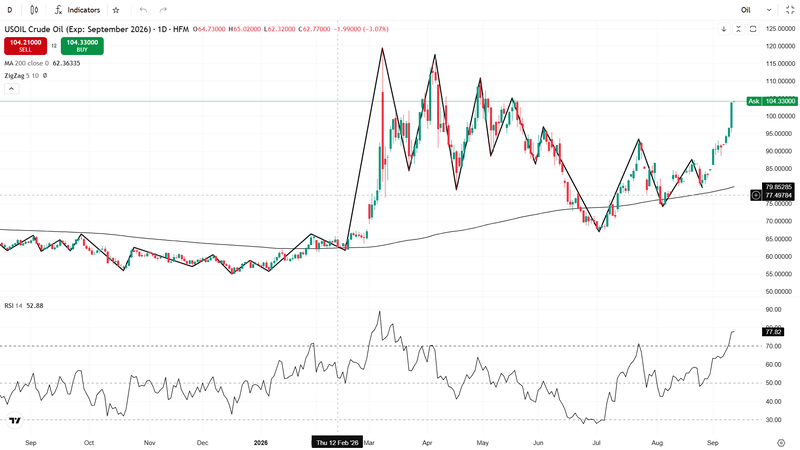
The move matters because oil is not only a commodity story. A sharp rise in crude can affect inflation expectations, bond yields, central-bank policy, the US dollar and equity-market sentiment. For traders, the key question is not just where oil trades today, but whether higher prices become a short-term shock or a more persistent macro driver.
Oil returns as a macro market catalyst
Oil markets were already sensitive before the latest jump. The U.S. Energy Information Administration said in its Short-Term Energy Outlook that reduced shipments through the Strait of Hormuz were expected to lower global oil inventories and keep crude prices elevated, with Brent forecast to average around $85 per barrel in the third quarter of 2026.
That matters because the recent move above $100 shows how quickly geopolitical risk can add a premium to energy prices. When supply routes look vulnerable, traders may respond not only to physical inventory data, but also to headlines, shipping risk, OPEC signals and expectations about demand from major economies.
For commodity traders, this can increase short-term volatility in Brent and WTI. For macro traders, oil becomes a broader signal that may reshape expectations for inflation, rates and risk appetite.
Why higher oil prices matter for inflation
Oil affects inflation through several channels. The direct impact comes through fuel, transport and energy costs. The indirect effect can appear in logistics, production costs, business margins and inflation expectations. This is why a fast rise in crude prices is closely watched by bond markets and central banks.
The timing is important. The Bureau of Labor Statistics schedule shows that the August 2026 U.S. CPI release is due on September 11, 2026, at 8:30 a.m. ET. If consumer-price data confirm persistent inflation pressure, markets could reassess the Federal Reserve’s policy path. If the data show moderation, some of the pressure on yields and equities could ease.
The Federal Reserve’s next scheduled FOMC meeting is set for September 15–16, 2026. That puts oil, inflation data and policy expectations on the same market timeline, increasing the importance of incoming macro releases.
Potential impact on bonds, the dollar and equities
In bond markets, the main risk is that higher energy prices feed into inflation expectations and keep Treasury yields elevated. That can weigh on long-duration assets, especially growth stocks and sectors that are more sensitive to financing costs.
In foreign exchange, the US dollar could find support if traders believe the Fed has less room to loosen policy, or may need to keep conditions restrictive for longer. However, the dollar’s reaction will also depend on risk appetite, labour-market data and how other central banks respond to the same inflation shock.
In equities, the impact can be mixed. Energy companies may benefit from higher crude prices, while airlines, transport, consumer-discretionary businesses and energy-intensive industries may face margin pressure. Reuters also noted that rising oil prices and higher U.S. bond yields were weighing on global stock-market sentiment.
Scenarios traders may monitor
One possible scenario is gradual normalisation. If supply fears ease or shipping routes stabilise, oil prices could moderate. In that case, the inflation impulse from crude may lose strength, allowing markets to refocus on growth, labour data and corporate earnings.
A second scenario is persistent geopolitical risk. If tanker attacks, shipping disruption or regional tension continue, Brent and WTI could remain sensitive to headlines. Under this scenario, traders may continue to monitor inventory releases, shipping data, OPEC commentary and policy signals from major consuming countries.
A third scenario is a broader macro squeeze. Oil above $100 for a longer period could complicate the task of central banks by adding inflation pressure while also weakening consumption and business confidence. That combination may be particularly important for stock indices, bonds and currencies of energy-importing economies.
Risks and uncertainties
The oil rally should not be viewed as a one-way trend. Crude can correct quickly if supply concerns fade, demand weakens or producers adjust output. Markets also need to distinguish between a temporary supply shock and a more durable inventory problem.
Another risk is that higher energy prices may not fully pass through to core inflation. The Fed looks at several indicators, including CPI, PCE inflation, employment, wages and inflation expectations. The market reaction will therefore depend on the full data picture, not oil prices alone.
For leveraged products, volatility around energy prices, inflation data and central-bank meetings can amplify risk. Traders may need to remain alert to sharp moves around data releases and geopolitical headlines.
What traders are watching now
The most important areas to watch are Brent and WTI price action, supply-route developments, U.S. inflation data, Treasury yields and the market’s interpretation of the September Fed meeting. Any sign that higher oil prices are feeding into inflation expectations could influence bonds, the dollar and equity sentiment.
Oil is again acting as a cross-asset catalyst. Its final impact will depend on how long supply concerns last, whether demand remains resilient and how central banks interpret the inflation risk.
Conclusion
Oil above $100 has brought energy markets back into the centre of global macro analysis. The move could affect inflation expectations, Fed policy pricing, Treasury yields, the US dollar and stock-market sentiment.
For traders, the most useful approach is to monitor the interaction between oil prices, inflation data and central-bank expectations rather than assuming a single outcome. The outlook could shift quickly as new supply, demand and macro data emerge.


เงื่อนไขเป็นไปตามที่บริษัทฯ กำหนด
คลิกเพื่อดู ปฏิทินเศรษฐกิจ
ข้อจำกัดความรับผิดชอบ: สื่อนี้จัดทำขึ้นเพื่อเป็นสื่อการตลาดทั่วไปเพื่อวัตถุประสงค์ในการให้ข้อมูลเท่านั้น และไม่ถือเป็นการวิจัยหรือวิเคราะห์การลงทุน สื่อนี้ไม่มีคำแนะนำการลงทุน หรือการชักชวนเพื่อซื้อหรือขายตราสารทางการเงินใดๆ ข้อมูลทั้งหมดที่จัดทำขึ้นรวบรวมจากแหล่งที่มาที่มีชื่อเสียง และข้อมูลใดๆ ที่มีการบ่งชี้ประสิทธิภาพในอดีตไม่ถือเป็นหลักประกันหรือตัวบ่งชี้ประสิทธิภาพในอนาคตที่เชื่อถือได้ ผู้ใช้รับทราบว่าการลงทุนในผลิตภัณฑ์ที่มีการกู้ยืมเงินนั้นมีลักษณะความไม่แน่นอน และการลงทุนใดๆ ในลักษณะนี้มีความเสี่ยงสูงซึ่งผู้ใช้ต้องรับผิดชอบแต่เพียงผู้เดียว เราไม่รับผิดชอบต่อการสูญเสียใดๆ ที่เกิดจากการลงทุนใดๆ ที่ทำขึ้นตามข้อมูลที่จัดทำขึ้นในสื่อนี้ ห้ามทำซ้ำหรือแจกจ่ายสื่อนี้ต่อไปโดยไม่ได้รับอนุญาตเป็นลายลักษณ์อักษรล่วงหน้าจากเรา
Jarek Duque
Financial markets analyst with over 10 years of technical and operational experience in the FX and CFDs sector. Jarek has been an integral part of large-scale international projects, managing content localization and the implementation of educational frameworks for global firms across multiple regions. His participation in market expansion across APAC and Latam provides him with a privileged understanding of the macroeconomic factors driving today's industry. Recognized for his work as a leader in financial training, he has coordinated live education programs for international audiences. Today, he leverages this extensive background to offer a rigorous analytical perspective connected to the reality of global markets and the world economy.
