


Why Is the Japanese Yen Falling After the BoJ Rate Hike?
The Bank of Japan has raised rates to their highest level since the 1990s, but the Japanese Yen is still declining? The US Dollar rose 0.75% against the Japanese Yen in the hours after the announcement. The Japanese Yen is currently the worst-performing currency of the day and the week. Why is the Japanese Yen declining?
Bank of Japan - Rate Hike Not Enough When Global Banks Outpace You
The Bank of Japan’s main interest rate has risen from 1.00% to 1.25%, the highest since 1995. The BoJ has also hiked the fastest pace since 1990. Hikes and higher interest rates are traditionally positive for the currency. However, the Japanese Yen is coming under immense pressure in the short term.
The main reason for the decline is the split decision and the general central bank stance in September. In September, the Federal Reserve, European Central Bank, as well as others, took a relatively hawkish tone. As a result, economists believe most central banks will continue hiking in autumn and winter. Therefore, for the Japanese Yen to gain, the Bank of Japan needed to sound equally hawkish.
The main issue for the market was the split decision. The Federal Reserve and European Central Bank made unanimous decisions to increase rates, whereas the Bank of Japan’s voting committee saw two members vote for a pause, not a hike. Toichiro Asada and Ayano Sato voted against the hike, signalling some resistance to accelerating the pace of rate increases to the fastest level in more than three decades.
Previously, investors were expecting a rate hike from the BoJ, with a further hike in December. Now, the market is likely to remove the pricing for an additional hike. Lastly, the BoJ is expected to keep rates unchanged for the rest of the year, while other central banks may raise rates by another 0.25%. This wider interest-rate gap could weaken the Japanese Yen and make it more attractive again for carry trades.
Lastly, the Japanese Yen was trading more than 5% higher against the US Dollar meaning investors looking to buy would have found the USD/JPY attractive. Technical analysis for the Japanese Yen will follow below.
USD/JPY - Technical Analysis
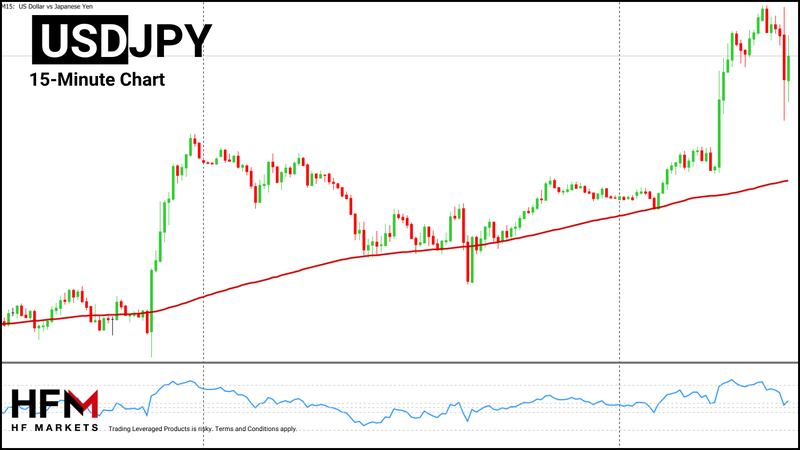
On the 5-minute and 30-minute charts, USD/JPY remains strongly bullish following the BoJ decision. The price is clearly trading above key moving averages and at elevated levels on oscillators. Short-term momentum remains positive, although the sharp rise has pushed the market into overbought territory. Even though the RSI indicates that the price is overbought, price action will not indicate a bearish move unless the price falls below 156.870.
On the 4-hour chart, the broader recovery remains bullish after USD/JPY rebounded from 152.89 earlier this month and broke above the important 156.50 resistance area. Holding above this level would keep buyers in control, with 157.70-158.00 becoming the next area to watch. However, a move back below 156.50, and particularly below 155.45, would weaken the bullish structure and increase the possibility of a deeper correction.
GBP/JPY - Technical Analysis
The British Pound is also one of the weakest-performing currencies of the week, and the Bank of England was one of the only central banks to pause in September.
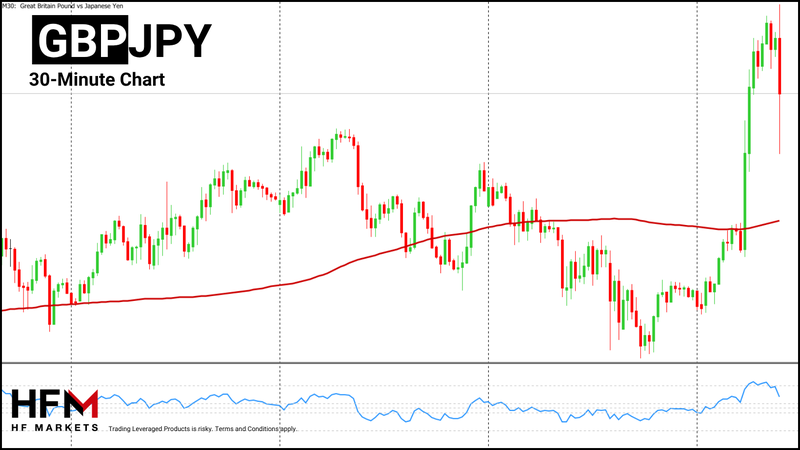
Nonetheless, on the 5-minute and 30-minute charts, GBP/JPY is showing strong bullish momentum following the BoJ decision. Moving averages are firmly positive and momentum indicators remain bullish, although the RSI has moved into overbought territory, suggesting the possibility of a short-term pullback. Immediate resistance is around 210.10-210.35, followed by 210.70, while 209.40 and 208.80 are the main short-term support areas.
On the 4-hour chart, the broader structure also remains bullish, supported by the latest breakout above 209.00. As long as GBP/JPY holds above 208.50-209.00, buyers remain in control, and a sustained break above 210.35-210.70 could open the way for further upside.
Key Takeaways:
- The BoJ raised its policy rate to 1.25%, the highest level since 1995.
- The Yen weakened as the split vote reduced expectations for further near-term rate hikes.
- A wider interest-rate gap with other major central banks could continue to pressure the Yen.
- USD/JPY and GBP/JPY remain technically bullish, although short-term momentum is approaching overbought levels.


Terms and Conditions apply
Click here to access our Economic Calendar.
Disclaimer: This material is provided as a general marketing communication for information purposes only and does not constitute an independent investment research. Nothing in this communication contains, or should be considered as containing, an investment advice or an investment recommendation or a solicitation for the purpose of buying or selling of any financial instrument. All information provided is gathered from reputable sources and any information containing an indication of past performance is not a guarantee or reliable indicator of future performance. Users acknowledge that any investment in Leveraged Products is characterized by a certain degree of uncertainty and that any investment of this nature involves a high level of risk for which the users are solely responsible and liable. We assume no liability for any loss arising from any investment made based on the information provided in this communication. This communication must not be reproduced or further distributed without our prior written permission.
Michalis Efthymiou
Michalis Efthymiou has extensive experience within the financial sector throughout the UK and Europe. After spending 5 years in London where Michalis operated as a financial advisor and an underwriter, he then entered the market analysis sector.
Additionally, he held training sessions and seminars in over seven countries across the globe and is now focused on providing investors with the required guidance to operate within the market with full confidence.
His teaching methods are based on technical analysis, fundamental analysis and order flow analysis, as well as how to view the market from an institutional angle.
