


Yuan Strengthens as G10 Weakens What Is Really Happening
The foreign exchange market is presenting an interesting puzzle. The dollar index (DXY) held around 102, while the offshore yuan rose to around 6.69 per dollar on Friday. At the same time, the euro, pound, and yen were under pressure. Naturally, investors are asking: why is the yuan moving against the tide?
Two Seemingly Conflicting Narratives
First, it is worth noting that the yuan has not strengthened against the dollar alone. Bloomberg's version of the CFETS RMB index rose to 103.9, its highest since April 2022, with a year-to-date gain of more than 5%. This means the yuan is strengthening against many trading partners at once.
In addition, the DXY does not include the yuan in its basket. The index is dominated by the euro, yen, pound, Canadian dollar, Swedish krona, and Swiss franc. So a ‘strong dollar’ actually means the dollar is strong against G10 currencies, not against the entire world.
The Central Bank Holds the Steering Wheel
The first factor is policy, not the free market. The PBOC strengthened its daily fixing for the eighth consecutive session on 18 September, its longest streak since 2023. By the end of September, the streak had reached its tenth session.
However, this strengthening is measured. The central bank still kept the fixing weaker than market levels, signalling a preference for gradual appreciation. In other words, Beijing is allowing the yuan to rise, but does not want a sharp spike.
Exports and Dollar Conversion Flows
The second factor comes from the real economy. China recorded a record trade surplus of nearly $1.2 trillion in 2025, about 6% of GDP. Exporters who receive dollars must convert them into yuan. As a result, demand for the yuan continues to build.
A surge in exports and strong conversion flows have been cited as underpinning the yuan's rally, which is now heading for its seventh consecutive quarterly gain. Exports of high-tech products, including AI-related goods, are reinforcing this trend.
European Pressure and Trade Diplomacy
The third factor is political. The European Union runs a trade deficit with China of more than €1 billion per day. The annual deficit reached €360.6 billion in 2025, up 15%, and German Chancellor Friedrich Merz considers the yuan undervalued by 25% to 30%. Goldman Sachs has also said the yuan is undervalued by at least 20% in some of its models.
On the other hand, the PBOC rejected these accusations. In a statement on 8 October, the central bank stressed that China has no intention of weakening its currency to gain a trade advantage. Even so, this stance does not mean Beijing opposes a strong yuan. As ANZ strategists noted, the PBOC appears comfortable with further strengthening, although it disagrees on the extent of the undervaluation.
Critically, this gradual strengthening also serves to dampen political pressure. By letting the yuan rise slowly, Beijing gives Europe fewer reasons to take tougher trade measures. This is an interpretation, not an official admission.
The Yield Differential Paradox
This is the most interesting part. Normally, a wide yield gap encourages investors to sell the yuan to buy dollars. This time, however, is different. The yuan has kept rising even as bets on Fed rate hikes pushed up yields and the dollar, widening the China–US yield gap to a record.
Thus, the carry trade is not the main driver. Export flows and policy guidance have proven more dominant. As a consequence, the yuan's strength is more fragile when viewed from a yield perspective.
The G10 Is Weakening Due to Its Own Problems
Meanwhile, the weakness in G10 currencies has varied causes. The euro has been pressured by sluggish growth and France's fiscal crisis. As a result, the euro has fallen more than 10% against the yuan from its January peak. The euro is trading near $1.12, close to its weakest level since mid-2025, while the pound has fallen to around $1.32 and the yen is holding around 158 per dollar. The dollar has even hit its highest level of the year against the euro and the Canadian dollar.
So the yuan looks strong partly because its counterparts are weak. This strength does not fully reflect an overheating domestic economy. In fact, Wells Fargo believes China's core price pressures remain low due to weak demand, leaving room for further PBOC easing. A strong currency amid sluggish domestic demand is a combination worth watching.
Risks and Levels to Watch
Although the trend is upward, risks remain. The PBOC itself has cautioned that the yuan's future direction is still uncertain, and the authorities can use macroprudential measures to curb volatility. In addition, the size of the gain varies depending on the basis of calculation, ranging from around 4% since the start of the year to around 9% cumulatively since 2025.
As for projections, the median of a Bloomberg survey sees the dollar ending the year at CNH 6.70, although there is room toward 6.60. This means the consensus does not expect a major surge from here.
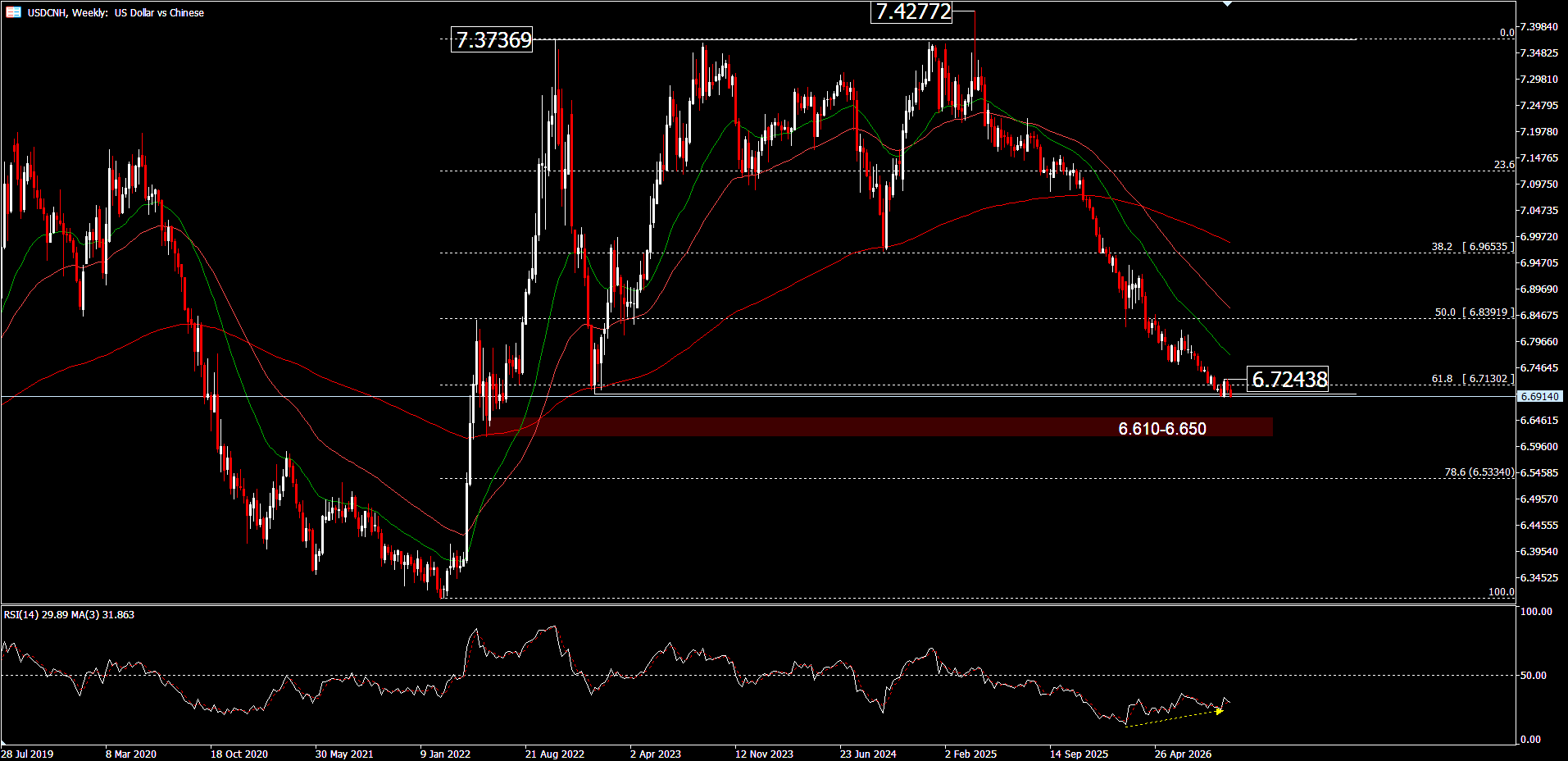
Technically, USD/CNH on the weekly chart is in an established downtrend, which means the yuan is strengthening against the dollar. The price, at 6.6914, has fallen from its 2025 peak (a spike around 7.42, with a Fibonacci swing high at 7.3736) and has formed a consistent series of lower highs. The EMA structure is fully bearish: the price is below the 20, 50, and 200 EMAs, all three of which are sloping downward and aligned in descending order. The pair is testing the 0.618 Fibonacci retracement, with the latest candle having a small body and partially breaking below that level. This indicates that the decline is starting to slow but has not yet reversed.
The RSI is oversold at 29.89 and sits higher than the early-2026 trough, when a bullish divergence was recorded. Bearish momentum is therefore weakening, but there is no confirmation of a reversal yet. The nearest support lies in the yellow zone around 6.61–6.65, the area where the 2022 breakout originated. If this zone is broken on a weekly close, the next target is the 0.786 Fibonacci level at 6.5334.
Conversely, a weekly close above 6.7243 would open the way for a corrective rebound toward the 20 EMA (6.7494). Greater upside would only open above the 0.5 Fibonacci level (6.8391) and the 50 EMA (6.8523), and only a break above those levels would weaken the current downtrend. As long as the price remains below the 20 EMA, the bias for USDCNH stays bearish.
However, the move is likely to be gradual rather than sharp, as the PBOC manages the fixing to keep the yuan's appreciation slow. This is consistent with the Bloomberg survey that sees USDCNH around 6.70 at year-end, with room toward 6.60. With the RSI near oversold and the price clinging to the 0.618 Fibonacci level, a short-term technical bounce may occur before the downtrend resumes.
This week, market participants should monitor three things:
- the PBOC's daily fixing as a signal of policy direction;
- China's CPI and PPI data on Wednesday;
- and the progress of China–EU trade negotiations.
For the dollar, the yuan's strength is an additional headwind at the margin. However, the main drivers of the DXY remain US CPI data and Fed expectations. For the full picture, read the dollar outlook for this week: DXY awaits US CPI and the midterms. In the commodities market, the dollar's loss of momentum has also given precious metals some breathing room, as seen when gold prices rose toward $4,200 while yields, the dollar, and oil declined.
Conclusion
Ultimately, the yuan has strengthened due to a combination of policy, export flows, and political pressure, not because of superior yields or growth. Conversely, the G10 currencies have weakened due to their own respective problems, ranging from France's fiscal situation to global yield pressures. Therefore, the yuan's strength is better read as a managed appreciation. As long as Beijing keeps its pace gradual, the rally could continue. Still, it remains dependent on the authorities' decisions.
Sources: Bloomberg – Yuan Hits Four-Year High Versus Basket, Reuters via Yahoo Finance – China defends yuan policy dan HFM – Today's Stock Market.


Tertakluk kepada Terma dan Syarat
Klik di sini untuk mengakses Kalendar Ekonomi kami
Peringatan: Bahan pemasaran ini bertujuan untuk maklumat sahaja dan tidak boleh dianggap sebagai nasihat perdagangan. Ia juga tidak mengandungi nasihat pelaburan, cadangan, atau pelawaan untuk tujuan membeli atau menjual mana-mana instrumen kewangan. Semua maklumat yang diberikan diperoleh daripada sumber yang sahih dan sebarang maklumat yang mengandungi petunjuk prestasi lalu tidak menjamin prestasi masa hadapan. Pengguna memahami bahawa dagangan produk berleveraj adalah berisiko dan bertanggungjawab sepenuhnya atas sebarang pelaburan sedemikian. Kami tidak bertanggungjawab atas sebarang kerugian daripada pelaburan berdasarkan maklumat ini. Sebarang pengeluaran semula atau pengedaran semula bahan ini memerlukan kebenaran bertulis terlebih dahulu dari pihak kami.
Ady Phangestu
Ady Phangestu ialah penulis buku teknikal mengenai analisis pertukaran mata wang asing, seorang pedagang dan tenaga pengajar dalam bidang Forex yang telah menganjur seminar di seluruh Indonesia bersama HF Markets. Beliau telah berkecimpung dalam dunia perdagangan sejak tahun 2009. Kini, beliau masih aktif sebagai penulis serta menawarkan kelas secara fizikal dan dalam talian tentang asas pertukaran mata wang asing dan pengenalan kepada produk kewangan.
